

What to Expect with Saline Infusion Sonohysterography (SIS)
When you’re navigating fertility testing or investigating symptoms like abnormal bleeding, your provider may recommend a Saline Infusion Sonohysterography (SIS). If you’re wondering what this procedure involves and why it’s important, you’re not alone. Here’s a clear, step-by-step guide to SIS—plus insight into why your physician might order it and what they hope to learn.
What Is Saline Infusion Sonohysterography (SIS)?
SIS is a specialized ultrasound procedure that provides a detailed look at the inside of your uterus. By gently infusing sterile saline (salt water) into the uterine cavity during a transvaginal ultrasound, SIS allows your provider to see the shape and lining of your uterus with much greater clarity than a standard ultrasound alone. This enhanced view helps detect subtle abnormalities that could affect fertility, menstrual health, or pregnancy outcomes.
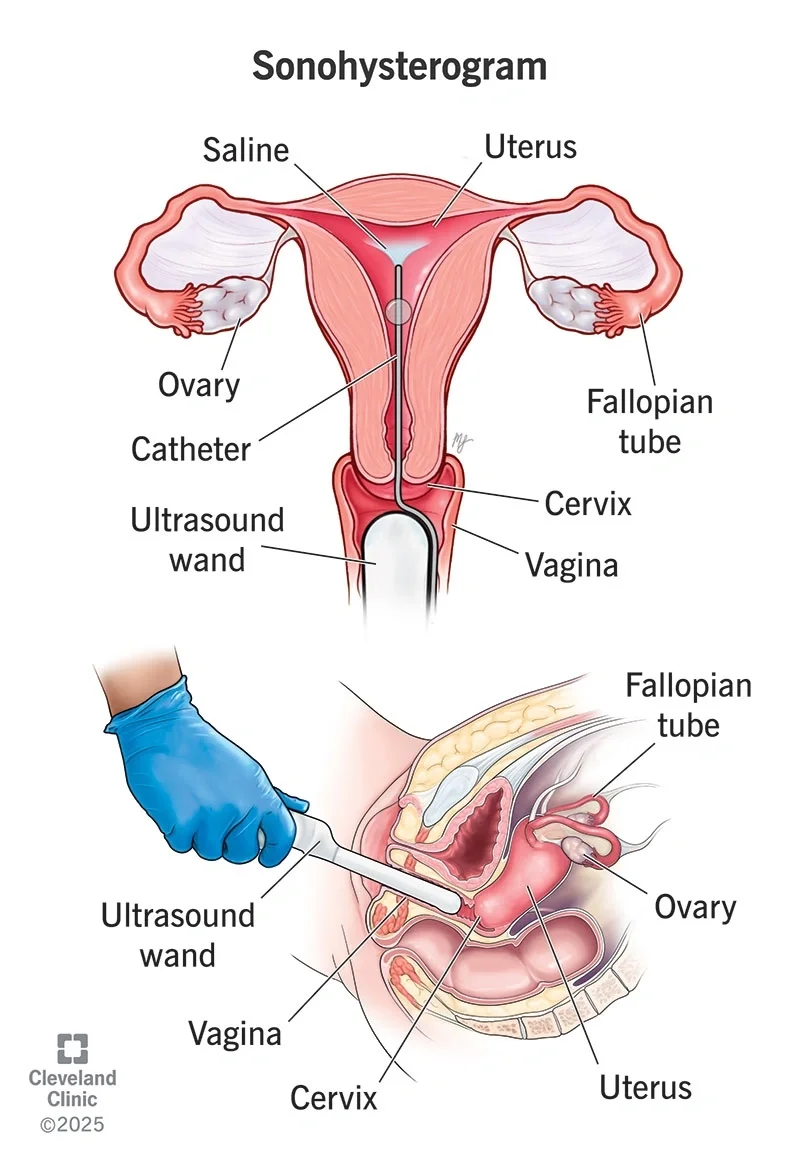
Illustration of a sonohysterogram from the Cleveland Clinic
Why Might Your Doctor Recommend SIS?
Physicians order SIS for several reasons, including:
-
Evaluating unexplained infertility or repeated miscarriages: SIS can reveal uterine polyps, fibroids, scar tissue (adhesions), or congenital anomalies that might interfere with embryo implantation or increase the risk of miscarriage.
-
Investigating abnormal uterine bleeding: If you experience heavy, irregular, or postmenopausal bleeding, SIS helps identify structural causes.
-
Clarifying inconclusive ultrasound findings: If a standard ultrasound suggests something abnormal but isn’t clear, SIS provides a more detailed view.
-
Pre-IVF or fertility treatment assessment: Before starting treatments like in vitro fertilization (IVF), SIS ensures the uterine cavity is healthy and free of obstacles to implantation.
-
Assessing the uterine cavity after surgery or treatment: SIS can check for healing or new issues after prior procedures.
What Can SIS Diagnose?
SIS is especially useful for detecting:
-
Endometrial polyps (small tissue growths inside the uterus)
-
Submucosal fibroids (muscle tumors that grow into the uterine cavity)
-
Scar tissue (Asherman’s syndrome)
-
Uterine septum or other congenital anomalies
-
Abnormal uterine shape or contour
It can also help assess the patency (openness) of the fallopian tubes, though it’s not the primary test for tubal evaluation.
Step-by-Step: What to Expect During SIS
1. New Patient Appointment
During your initial consult, you’ll meet with a provider to discuss your medical history, symptoms, and family-building goals. Your provider may perform a physical exam, vaginal ultrasound, and bloodwork to assess your reproductive health. If SIS is recommended, your care team will explain the next steps.
2. Scheduling Your SIS
A member of our team will help you schedule the SIS. Typically, this test is scheduled after your period but before ovulation (cycle days 6–12), when the uterine lining is thinnest for optimal imaging. Your care team will help you pick the best date.
3. Pre-Procedure Preparation & Arrival
Your physician may advise you to take an over-the-counter pain reliever (like ibuprofen) before your procedure. Please follow any additional instructions from your care team as well, such as arriving with a full bladder if requested. On the day of the procedure, please plan to arrive around 10-15 minutes early at the clinic to complete any complete paperwork and confirm your medical history.
4. The SIS Procedure
This procedure will take place in one of our clinic exam rooms and will last approximately 20-30 minutes. After changing into a medical gown, you’ll lie down on the exam table. A speculum is gently inserted into the vagina (similar to a Pap smear). Your cervix will be cleaned, and a thin catheter is placed through the cervix into the uterus. Sterile saline is slowly infused to gently expand the uterine cavity and a transvaginal ultrasound probe is used to visualize the uterus and endometrial cavity in real time. Your provider may ask to shift your position for better imaging.
Many patients only experience mild cramping or discomfort during the procedure, which resolves quickly.
5. Post-Procedure Recovery & Results
You may experience mild cramping or spotting after the procedure, but most patients resume normal activities the same day. Your care team will review the images and discuss findings with you, either immediately or during a follow-up. If further evaluation or treatment is needed, your care team will contact you to discuss next steps.
Is SIS Safe?
SIS is considered a safe, low-risk procedure. Complications are rare but may include mild cramping, spotting, or (very rarely) infection. Your provider will review any risks with you and answer your questions before the procedure.
The Bottom Line
Saline Infusion Sonohysterography is a valuable tool for diagnosing uterine conditions that can impact fertility, menstrual health, and pregnancy outcomes. By providing a clear, detailed view of the uterine cavity, SIS helps your provider develop the most effective treatment plan for your needs.
If you have questions or think SIS might be right for you, don’t hesitate to reach out. Schedule a consultation with our team today to discuss your options and take the next step toward your family-building goals. Your care team is here to support you every step of the way.