


How to Read a Semen Analysis: Understanding Your Results
A semen analysis report can be intimidating at first glance — a page of numbers, percentages, and unfamiliar medical terms. But each line is simply describing a different aspect of sperm health, and once you know what to look for, the picture becomes much clearer. This guide explains what each parameter means, what counts as a typical result, and what different findings might suggest for your next steps.
One thing to keep in mind throughout: a semen analysis is a snapshot, not a final verdict. Your results are best understood in conversation with a fertility specialist who can interpret them alongside your medical history and your partner’s.
Before you read the numbers
Most laboratories compare your results against reference values published in the World Health Organization (WHO) laboratory manual, 6th edition (2021). These values come from a large group of men whose partners conceived naturally within a year of trying. They represent the lower end of that fertile group — specifically the 5th percentile — which is an important distinction:
• A result below a reference value does not mean you cannot father a child. Many men with below-range results conceive, sometimes naturally.
• A result within range does not guarantee conception, because fertility also depends on factors a semen analysis cannot measure.
• Sperm production varies naturally from week to week, so a single sample is rarely the whole story. Abnormal results are usually confirmed with a repeat test.
In other words, treat these numbers as reference points that guide a conversation, not as a pass-or-fail score.
Quick reference: typical values
Here are the WHO 6th edition lower reference values for the main parameters. Each is explained in more detail in the sections that follow.
|
Parameter |
Typical reference value |
|
Semen volume |
1.4 mL or more |
|
Sperm concentration |
16 million per mL or more |
|
Total sperm number |
39 million per ejaculate or more |
|
Total motility (any movement) |
42% or more |
|
Progressive motility (forward movement) |
30% or more |
|
Vitality (live sperm) |
54% or more |
|
Morphology (normal shape) |
4% or more normal forms |
|
pH |
7.2 or higher |
Note: Different laboratories may present results in slightly different units or formats, and some still reference the older 5th edition (2010) values. If your report’s numbers look different, ask which standard was used.
Understanding each parameter
Semen volume
This is the total amount of fluid in a single ejaculate, with a typical value of 1.4 mL or more. A low volume can simply reflect a short abstinence period or an incompletely collected sample, but it can also point to a blockage, a hormonal issue, or retrograde ejaculation (where semen travels backward into the bladder). Volume on its own says little about fertility; it matters most alongside the sperm numbers.
Sperm concentration and total sperm number
These are the two counting measures, and they are often the first thing people look for. Concentration is the number of sperm in each milliliter of semen (typically 16 million/mL or more), while total sperm number is the count across the whole sample (typically 39 million or more). A low count is called oligozoospermia. When no sperm at all are found in the ejaculate, the term is azoospermia, which always warrants specialist evaluation, since it can be caused either by a blockage or by a production problem — two situations with very different treatments.
Motility
Motility describes how well sperm move, and it is reported in two ways. Total motility is the share of sperm showing any movement (42% or more), and progressive motility is the share swimming forward effectively (30% or more). Progressive movement matters most, because sperm need to travel to reach and fertilize an egg. Poor motility is called asthenozoospermia and can result from factors such as infection, a varicocele, lifestyle influences, or prolonged abstinence before the test.
Vitality
Vitality measures the percentage of sperm that are alive (54% or more). It is especially useful when motility is low: it tells the lab whether the sperm are immobile because they are dead, or alive but simply not moving well — a difference that can influence treatment choices.
Morphology
Morphology assesses the percentage of sperm with a normal shape (4% or more normal forms, using strict criteria). That figure surprises many people, but it is normal for the large majority of sperm to have minor irregularities. A low proportion of normal forms is called teratozoospermia. On its own, modestly low morphology often has limited impact, and it is interpreted together with the other parameters.
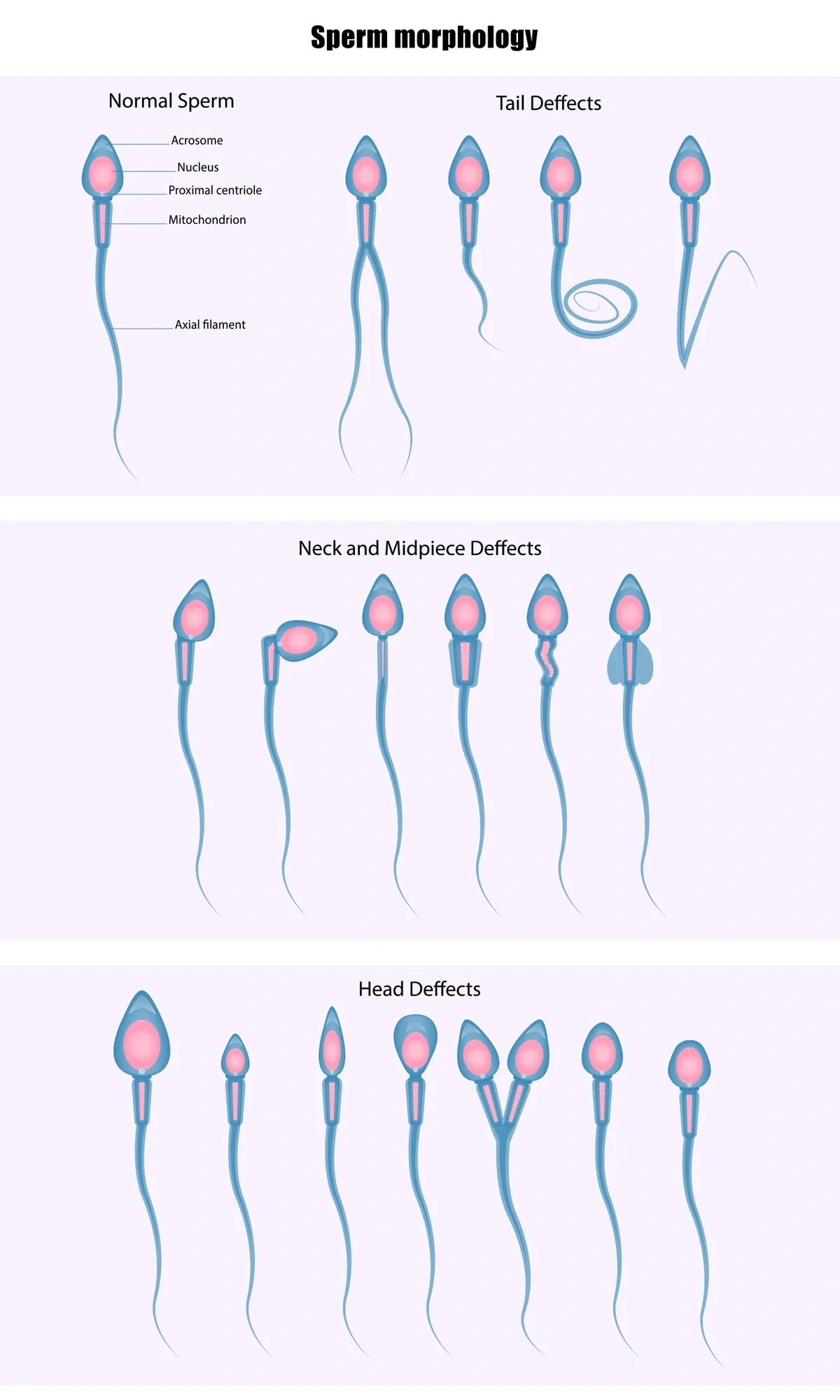
Illustration of sperm morphology
pH, liquefaction, and appearance
The lab also records the sample’s pH (normally 7.2 or higher), how quickly it liquefies (usually within about 60 minutes), and its general appearance. Abnormalities here can hint at infection, inflammation, or a problem with the accessory glands that contribute to semen.
White blood cells and clumping
A raised level of white blood cells (above roughly 1 million/mL, termed leukocytospermia) may indicate infection or inflammation. Agglutination, or clumping of sperm, can sometimes suggest the presence of antisperm antibodies. Both are flags for further investigation rather than diagnoses in themselves.
Decoding the medical terms
Your report or physician may use a shorthand vocabulary. Here is what the common terms mean:
-
Normozoospermia — all parameters within reference ranges.
-
Oligozoospermia — low sperm concentration or count.
-
Asthenozoospermia — reduced motility.
-
Teratozoospermia — a low proportion of normally shaped sperm.
-
Oligoasthenoteratozoospermia (OAT) — low count, motility, and morphology together.
-
Azoospermia — no sperm in the ejaculate.
-
Leukocytospermia — an elevated number of white blood cells.
Next steps, based on your results
If your results are within range
This is reassuring news. If you and your partner are still having difficulty conceiving, the next step is usually to ensure the female partner has been evaluated, to review the timing of intercourse around ovulation, and to give it a reasonable window of time. If conception still does not happen, return to your physician to discuss further options.
If your results are borderline or mildly abnormal
Mild abnormalities are common and frequently improve. Because it takes roughly two to three months for the body to produce a new batch of sperm, a repeat semen analysis after about 8 to 12 weeks is the standard next step to confirm the finding rather than acting on a single sample. In the meantime, addressing reversible factors can make a meaningful difference:
-
Stop smoking and limit alcohol.
-
Avoid excess heat — hot tubs, saunas, and laptops resting directly on the lap.
-
Aim for a healthy weight, regular activity, and a balanced diet.
-
Review medications and supplements with your doctor, as some can affect sperm.
-
Mention any recent fever or illness, which can temporarily lower results.
If your results are significantly abnormal
Markedly low values, or a diagnosis such as azoospermia, are a signal to see a reproductive urologist or andrologist rather than a reason to lose hope. Your fertility specialist can order and/or refer you for the right follow-up, which may include:
-
Hormone blood tests (testosterone, FSH, LH, prolactin) to understand how the body is signaling sperm production.
-
A physical exam and scrotal ultrasound to check for a varicocele or blockages.
-
Genetic testing in certain cases of very low or absent sperm.
-
Sperm DNA fragmentation testing to assess genetic integrity that a standard analysis cannot see.
Depending on the cause, treatment options range from correcting a reversible problem (such as repairing a varicocele or treating an infection) to assisted reproduction. Techniques such as intrauterine insemination (IUI), in vitro fertilization (IVF), and intracytoplasmic sperm injection (ICSI) (where a single sperm is injected directly into an egg) mean that even significant sperm issues can often be overcome. When no sperm appear in the ejaculate, surgical sperm retrieval can sometimes recover sperm directly from the testicle for use in treatment.
The bottom line
Reading a semen analysis comes down to understanding that each parameter describes a different facet of sperm health, that the reference values are guides rather than guarantees, and that almost no result is the end of the road. The most useful next step after any analysis — normal or not — is to review it with a fertility specialist who can put the numbers in context and map out a plan that fits your situation.