


What Is PGT-A? Genetic Testing of Embryos Explained
If you're preparing for IVF, you've probably come across the term PGT-A — and a lot of questions along with it. Is this embryo healthy? Which one gives us the best chance? Could testing help us avoid another miscarriage? Genetic testing of embryos can feel like one of the more technical parts of the fertility journey, but the core idea is straightforward. Here's a clear, honest look at what PGT-A is, how it works, what your results mean, and who it tends to help most.
What Is PGT-A?
PGT-A stands for preimplantation genetic testing for aneuploidy. It's a test performed on embryos created through in vitro fertilization (IVF) to check whether each embryo has the correct number of chromosomes before it's transferred to the uterus.
Most people have 46 chromosomes, arranged in 23 pairs. An embryo with the expected number is called euploid. An embryo with a missing or extra chromosome is aneuploid. Aneuploidy is one of the most common reasons an embryo fails to implant or a pregnancy ends in early miscarriage, so identifying it ahead of time gives your care team useful information when deciding which embryo to transfer first.
PGT-A is one of three types of preimplantation genetic testing. It's worth knowing how they differ, because the names sound similar:
-
PGT-A screens for the number of chromosomes (aneuploidy).
-
PGT-M tests for a specific inherited single-gene condition known to run in a family, such as cystic fibrosis.
-
PGT-SR looks for structural rearrangements, like translocations, in patients who carry them.
This article focuses on PGT-A, the most commonly discussed of the three. To learn how all testing options fit your situation, visit our preimplantation genetic testing page.
Why Chromosomes Matter So Much
The number of chromosomes in an embryo has a major influence on whether it can lead to a healthy pregnancy. Embryos with the wrong number often don't implant, or they result in miscarriage — frequently before a person even realizes they were pregnant.
The likelihood that an egg, and therefore an embryo, is chromosomally abnormal rises as a person ages. This is the single biggest reason fertility and miscarriage risk both change over time. It's also why PGT-A is discussed more often with patients of advanced maternal age or those who have experienced repeated pregnancy loss. Importantly, PGT-A doesn't change an embryo's chromosomes or improve egg quality — it's a way of learning more about the embryos you already have, not a treatment that makes them healthier.
How PGT-A Works, Step by Step
PGT-A happens partway through an IVF cycle, after eggs have been retrieved and fertilized. Here's the typical sequence:
-
Fertilization. Eggs are retrieved and fertilized in the lab, often using intracytoplasmic sperm injection (ICSI), which helps keep stray sperm DNA from interfering with the genetic test.
-
Blastocyst development. Embryos grow in the lab for about five to seven days until they reach the blastocyst stage, when they have enough cells to safely sample.
-
Biopsy. An embryologist gently removes a few cells from the trophectoderm — the part of the blastocyst that goes on to form the placenta, not the baby. The embryo itself is not harmed in the process.
-
Freezing. The biopsied embryos are frozen and stored while testing is completed, since results take time to come back.
-
Analysis. A genetics lab analyzes the sampled cells, usually with a technology called next-generation sequencing, and reports the chromosomal status of each embryo.
-
Transfer. Once results are in, your physician transfers a selected embryo in a later frozen embryo transfer cycle.
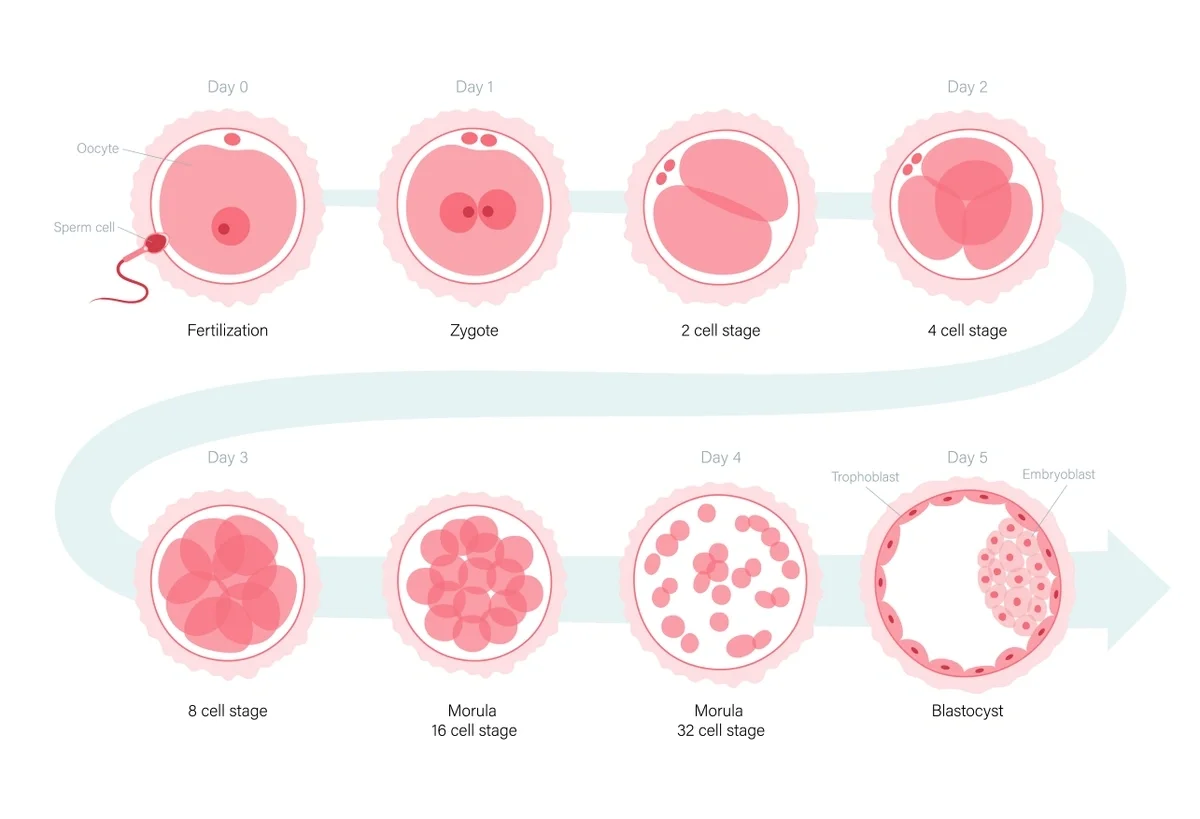
Illustration of embryo development
Because the embryos are frozen while you wait for results, PGT-A almost always involves a frozen transfer rather than a fresh one — a point worth keeping in mind when you're planning your timeline.
Understanding Your PGT-A Results
Results generally fall into three categories:
Euploid. The embryo has the expected number of chromosomes. These are typically prioritized for transfer because they have the best chance of leading to a healthy pregnancy.
Aneuploid. The embryo has a missing or extra chromosome. These are generally not recommended for transfer, as they're unlikely to result in a healthy birth.
Mosaic. This is an in-between result, where the sample contains a mix of normal and abnormal cells. Mosaic results are more nuanced than they sound. A growing body of evidence shows that some embryos reported as mosaic have gone on to become healthy pregnancies, and there is ongoing scientific debate about how reliably current testing identifies true mosaicism. If you receive a mosaic result, your physician and a genetic counselor will walk you through what's known, what isn't, and what makes sense for you. It's a conversation, not an automatic yes or no.
Who Might Benefit From PGT-A?
PGT-A isn't automatically the right choice for everyone, and a responsible answer depends on your individual history and goals. It's most often considered for patients who:
-
Are of advanced maternal age, when the chance of aneuploidy is higher
-
Have experienced recurrent miscarriage
-
Have had several embryo transfers that didn't result in pregnancy
-
Have a prior pregnancy affected by a chromosomal condition
-
Want to reduce the chance of transferring an embryo that's unlikely to succeed
For these patients, PGT-A may help shorten the time to a successful pregnancy, lower the risk of miscarriage, and support transferring a single embryo at a time — which reduces the risks that come with twins or higher-order multiples.
At the same time, it's worth being clear-eyed about the evidence. Major professional bodies, including the American Society for Reproductive Medicine, have noted that PGT-A has not been shown to improve live birth rates when used as a routine test for every IVF patient, particularly for those under 38. PGT-A is a selection tool that helps prioritize among the embryos you have; it doesn't increase the total number of healthy embryos, and it isn't a guarantee. That's exactly why the decision is best made together with your physician, based on your age, diagnosis, embryo numbers, and what matters most to you.
Benefits and Limitations at a Glance
Like any part of fertility care, PGT-A involves tradeoffs worth understanding before you decide.
Potential benefits: More information to guide which embryo to transfer first, a possible reduction in miscarriage risk for appropriate candidates, support for single-embryo transfer, and potentially fewer transfer cycles before a successful pregnancy.
Limitations to weigh: Added cost, the possibility that testing reveals no euploid embryos from a cycle, the complexity of mosaic results, and the fact that PGT-A screens for chromosome number — not every possible genetic or health condition. It also can't overcome the underlying effects of egg quality or age.
PGT-A at Indiana Fertility Institute
Deciding whether genetic testing belongs in your treatment plan is a personal decision, and you don't have to make it alone. The team at Indiana Fertility Institute will help you understand your options, weigh the benefits and limitations against your own history, and build a plan that fits your family-building goals.
If you'd like to talk through whether PGT-A is right for you, request a consultation or contact us today.