


Understanding Embryo Grading: What Makes a "Good" Embryo?
Your eggs have been retrieved and fertilized, your embryos are growing in the lab, and now your care team is talking about grades — "4AA," "3BB," a string of numbers and letters that can feel a little like a secret code. If you've found yourself wondering whether a certain grade means a "good" embryo or a "bad" one, you're in good company. Embryo grading is one of the most asked-about and most misunderstood parts of IVF. Here's what those grades actually describe, why they aren't identical from one clinic to the next, and — just as importantly — what a grade can't tell you.
What Is Embryo Grading?
Embryo grading is a way for embryologists to describe how an embryo looks as it develops in the lab. Using a microscope, they assess features like how many cells an embryo has, how evenly those cells are dividing, and how well its structures are forming. That assessment gets translated into a shorthand grade.
The purpose is practical: when you have more than one embryo, grading helps your team decide which one to transfer or freeze first. Think of it as a way of prioritizing, not a final judgment. A grade reflects an embryo's appearance and development at a moment in time — it is not a measure of your embryo's genetics or a promise about the future.
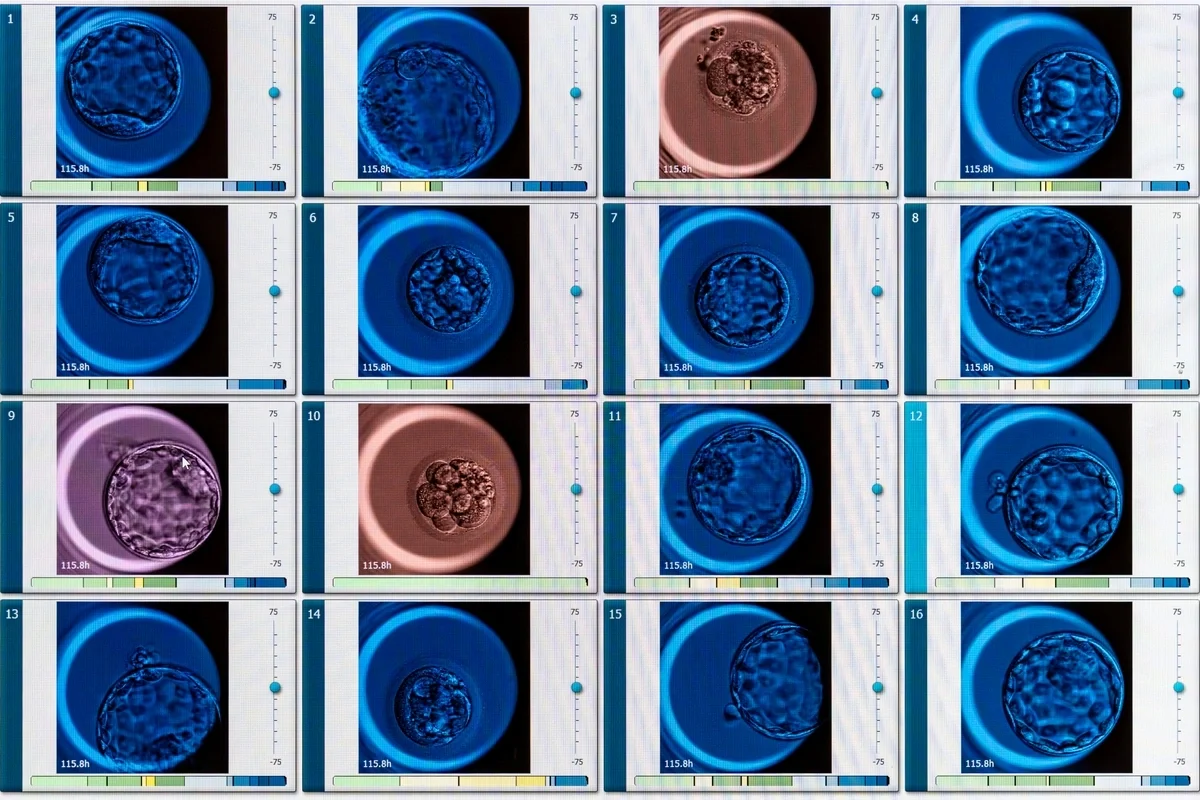
Image of embryo development monitoring
First, a Note on Timing: Day 3 vs. Day 5
Embryos are graded differently depending on their stage of development.
Around day 3 after fertilization, an embryo is at the cleavage stage — essentially a small ball of dividing cells. Around day 5, 6, or 7, a healthy embryo reaches the blastocyst stage, a more developed structure with a fluid-filled center and two distinct cell types. Most modern IVF programs grow embryos to the blastocyst stage before transfer, so blastocyst grading is what most patients end up hearing about. We'll cover both briefly.
Day 3 (Cleavage-Stage) Grading
At the cleavage stage, embryologists generally look at three things: the number of cells (an embryo around this point often has roughly eight), the evenness of those cells, and the amount of fragmentation (small bits of cellular material outside the cells, where less is preferred). Day 3 grades are often expressed as a number of cells plus a quality score. Not every embryo is graded at day 3, especially in programs that routinely grow embryos out to the blastocyst stage.
Blastocyst Grading: The Number and Two Letters
Blastocyst grading is the one that produces those familiar codes like 4AA. One widely used approach was developed by embryologist Dr. David Gardner in the late 1990s, and many labs use it or a variation of it. In this system, a blastocyst grade has three parts, written as a number followed by two letters — for example, 4AB.
The number (expansion): how developed the blastocyst is. This is usually scored on a scale of 1 to 6 and reflects how much the blastocyst has expanded and whether it's beginning to "hatch" out of its shell (the zona pellucida). A lower number generally indicates an earlier blastocyst, while higher numbers indicate a more expanded or hatching one:
-
1–2: an early blastocyst, with the fluid cavity taking up less of the embryo
-
3: a full blastocyst, with the cavity filling the embryo
-
4: an expanded blastocyst, with a larger cavity and a thinning shell
-
5: a hatching blastocyst, beginning to emerge from its shell
-
6: a fully hatched blastocyst
The first letter (inner cell mass, or ICM): the part that becomes the baby. The ICM is the cluster of cells that goes on to form the fetus. It's typically graded A, B, or C, where A generally describes many tightly packed cells and C describes very few.
The second letter (trophectoderm, or TE): the part that becomes the placenta. The trophectoderm is the outer layer of cells that contributes to the placenta and other supporting tissues. It's also typically graded A, B, or C, with A describing a cohesive layer of many cells.
So, as an illustration of how this common system reads:
-
4AA — an expanded blastocyst with strong-looking inner cell mass and trophectoderm
-
3AB — a full blastocyst with a strong inner cell mass and a slightly less developed trophectoderm
-
5BB — a hatching blastocyst with moderate ratings for both cell types
These examples show how the code is structured in one widely used system. They are not a scorecard for your own embryos, and — as we'll explain next — the very same code can mean something a little different from one lab to another.
Why a Grade at One Clinic Isn't the Same as a Grade at Another
This is the single most important thing to understand about embryo grading: grading systems are not standardized across clinics, and grading is partly a matter of expert judgment.
Two things drive this. First, labs use different scales. Some use the letters A, B, and C; others add a D, use A through F, apply plus and minus signs, or convert everything into numbers. Some labs use their own descriptive or proprietary systems entirely. Because of this, a "4AA" reported at one clinic is not necessarily identical to a "4AA" reported somewhere else.
Second, grading involves a trained human assessing appearance under a microscope. Two skilled embryologists can look at the same embryo and assign slightly different grades, which is completely normal. Reputable labs work hard to keep their grading consistent internally, but that consistency is within a lab, using that lab's system.
The practical takeaways:
-
Don't compare your grades to a friend's, or to numbers you find online. You may be reading two different scales.
-
Ask your own care team what your grades mean in their system. They can interpret your specific embryos in the context of your specific plan — which is the only comparison that matters.
What Grading Can — and Can't — Tell You
What it can do: On average, higher-graded blastocysts tend to have somewhat better implantation potential, which is why grading is useful for deciding the order in which to transfer embryos. It's a helpful prioritization tool.
What it can't do: Grading describes an embryo's appearance, not its chromosomes. A beautiful-looking, top-graded embryo can still be chromosomally abnormal, and a more modestly graded embryo can absolutely go on to become a healthy baby. Grades are also not fixed — an embryo graded on day 5 may look different on day 6 as it continues to develop, and a cell mass that looks less developed at one check can compact and improve at the next. A lower grade is not a dead end.
This is exactly why grading and genetic testing answer different questions.
How Grading and Genetic Testing Work Together
Embryo grading and preimplantation genetic testing (PGT-A) are complementary, not interchangeable. Grading looks at how an embryo is built and how it's developing; PGT-A looks at whether it has the expected number of chromosomes. Grading actually helps here in a concrete way: an embryo generally needs to reach the blastocyst stage with enough well-formed trophectoderm cells before it can be safely biopsied for genetic testing. If you'd like a fuller picture of chromosomal testing, see our companion article on what PGT-A is and how it works.
The Bottom Line
An embryo grade is one useful piece of information — not the whole story. Your age, the number of embryos you have, your medical history, and (if you've done it) genetic testing all factor into which embryo your physician recommends transferring first. It's natural to fixate on the letters, but try not to let a grade define your hope. Plenty of healthy babies have started as embryos that weren't "perfect" on paper.
Embryo Grading at Indiana Fertility Institute
If you're navigating IVF and want to understand what your embryos' grades mean for your plan, the team at Indiana Fertility Institute is here to walk you through it — in plain language, and always in the context of your individual journey rather than a single letter or number.
To talk through your options, request a consultation or contact us today.